ESCENAS PARA LA PELÍCULA
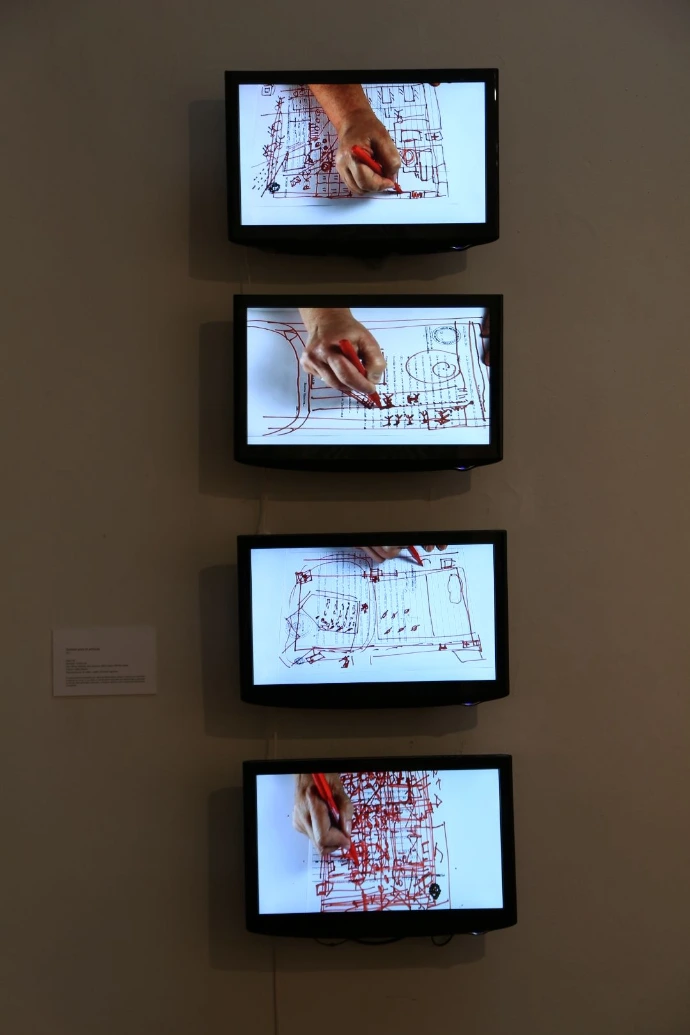
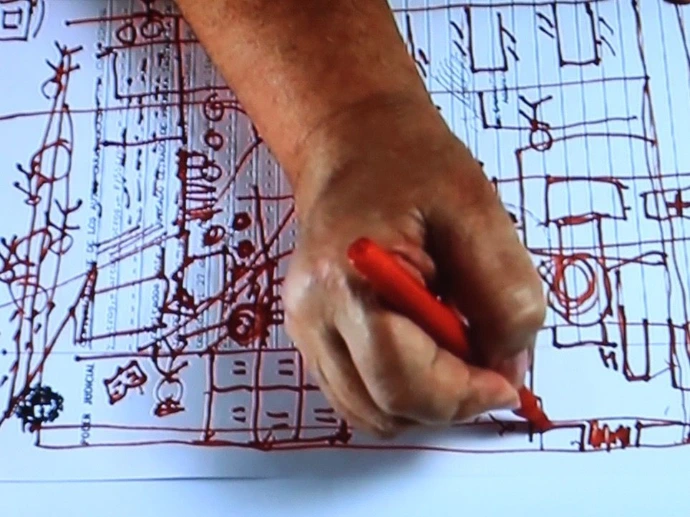
Former political prisoners, fellow inmates of Mirtha Cubas, recount 7 stories of situations the four of them lived through in prison. Over the course of several meetings with Tamara Cubas, and starting from their personal memories, they construct —through drawings— four versions of these shared scenes. In the videos we see the women's hands drawing the stories on each one's own release order.
CREDITS
TYPE: Video installation
FORMAT: 4 flat screens, 10 minutes each
PARTICIPANTS:
- Gloria Telechea
- Ana Demarco
- Nibia López
- Mirtha Cubas
TECHNICAL TEAM:
- Camera: Pablo Abdala
- Video and audio post-production: Francisco Lapetina
EXHIBITION: Solo exhibition "El día más hermoso", Montevideo 2012
PHOTOS
TEXTS
1. THE COLONEL
Along the 500-meter road from the prison entrance, the Colonel advances in his favorite vehicle: the ambulance. All his subordinates stop what they are doing and, standing at attention, follow the Colonel's route with their faces. The prisoners assigned to forced labor, cutting the grass by hand, take the chance to straighten their backs. Everything comes to a halt as he passes, except Joaquín the donkey, who along with the Colonel's vehicle is the only thing that moves. He enters the building and after a few minutes comes out on horseback to make his usual round. A soldier, as usual, runs behind him holding his saber in both hands as if it were a tray. They move among the goats, the prisoners, the hens and the pigs.
2. KITCHEN
In the middle of the kitchen, under the cooks' directions, lunch is being prepared. Standing on top of the stove is 209, stirring with an oar a pot of polenta that reaches up to her chest, calculating the moment the bubble will burst so she can pull her face and arms away and not get burned. To one side, a group of about 10 women with white kerchiefs on their heads, seated in a circle, is peeling potatoes for dinner. They take advantage of the moment to talk. Through the door comes 16, who spots an unwashed griddle on the stove. The soldiers used it the night before to cook a chop and left the bone and the fat. She hurries to gnaw the bone and savor the remaining juice. Other prisoners make remarks; she smiles. A soldier comes out with the menu on a tray for the officer in charge to taste. After lunch, the sector on duty is cleaning the pots, hosing them down in the back yard. The meat truck is parked nearby with its doors open, unloading the order. 283, with half her body inside the pot, scrapes the bottom while she ponders the possibility of seizing the occasion and escaping in the truck.
3. SALUTE TO THE FLAG
Before dawn the prisoners are woken; after dressing, they go out to the yard to line up and pay honors to the flag. First sector A, then sector B, C, E and finally the sector of the dangerous ones, D, who wear red pockets. The women soldiers thus begin their daily round-up of infractions: "don't fix your hair", "don't cough". These will earn them sanctions such as the suspension of visits or parcels, for what the report will state as "Attempted communication with a fellow inmate". In front of the lined-up prisoners, who wear only their thin gray uniforms, stands the Captain with other officers beneath thick wool ponchos. When the sun decides to rise, the bugle is heard announcing that the flag —which no one can make out— is being raised. The Captain draws his weapon and salutes the flag by bringing the pistol to his temple. 209 from sector E is watching the soldiers posted behind the wire fence and those up in the towers when she senses that, at the other end of the line, a fellow inmate who has balance problems from blows to her ears has fainted. She runs to her, lifts her in her arms and, like a civilian, crosses the yard, enters the building, goes through several doors until she reaches the infirmary. On her way out she realizes what she has done, and that she has not been stopped.
4. ALARM
It is midnight; sirens, shouts and the noise of padlocks are heard. The soldiers' shouts begin to change in tone. Hit the ground, several of them yell. One of the prisoners hurries and quickly grabs a deck of cards. Another manages to grab a blanket. They all throw themselves to the floor, looking for a space between the legs of the bunks, the crates that serve as tables and the logs they use as seats. All are face down except one. The gates of the sectors are open. The corridors are full of colonels, captains, majors, lieutenants, ensigns and women soldiers carrying gas masks and batons in their hands. Everyone runs back and forth shouting. In cell 3 a soldier is yelling "hit the ground" at the prisoner who is standing. She says she is exempt. The soldier shouts that she has to do it. She replies that she has heart problems and has been exempted. The soldier, screaming, orders her again: "hit the ground". They are all on the floor now; some, with half their bodies under the bunks, are playing a game of truco. Another has placed the blanket under her body. The soldiers' frenzied shouts mingle with metallic noises. The alarm ends. The prisoners return to their bunks. The one who insisted she was exempt is taken by ambulance to the military hospital. She has just had a cardiac arrest.
5. SEARCH
For a month the prisoners have been preparing an "escabio", a homemade brew made by fermenting the scraps of fruit they have managed to salvage. They hear the cell block door being opened with the violence typical of a search. Quickly they grab the brew and in seconds drink it all among themselves, just before the women soldiers arrive and order them to clear the cells. Now they are made to stand in the yard while the cells are searched. The escabio begins to take effect. After a while they return to the cells and calmly start sorting and separating the personal belongings scattered across the floor, among the fruit scraps, craft materials and wool from the mattresses. 16 breaks the silence and, laughing, says: "oooh look, the yocos have committed suicide", pointing at the remains of the yoca scattered on the floor. 206 confirms that her leather necklace is still hanging on the bunk, but that they have taken her book "The Day of the Jackal".
6. STRICT CONFINEMENT
The whole of Sector E has been punished with Strict Confinement for singing in chorus. Their sanction is one week locked in their cells, without going out to the yard, without parcels, without visits, and they must remain seated in pairs on the lower bed of the bunk. In the first cell they are staging a play they wrote themselves. They have built the set with bunks, mattresses and sheets. In the second, seated in a circle, they take turns telling stories. In the third, a literature student is giving them a class on the German Romantics. In the fourth they are debating the rules for living together in the cell. In the fifth cell they are singing in chorus. The voice of the woman soldier is heard saying "don't siiiiing". The cell block door opens and a soldier comes in to make her round. She passes in front of each of the cells, where everything is in order and the pair of prisoners from each bunk sits on the lower bed.
7. DUNGEON
220 is told she must go down to have her blood pressure taken. She is in the infirmary, and her belongings have just been brought into the next room. She starts shouting to warn her fellow inmates that she is going to be transferred. She is beaten by the officers. They transfer her to another unit, where she is placed alone in a punishment cell. Every day, early in the morning, an officer comes for her, puts a plastic bag over her head and takes her to the middle of the yard. There she must remain at gunpoint, guarded by two officers, for 30 minutes. When the time is up, the one who brought her returns and, again with the bag over her head, takes her back to her cell. One day, while in the bathroom, she sees in the wastebasket a newspaper clipping about the death of Roslik. 286 is in the punishment cell when the International Red Cross visits. Among the measures they demand be regularized is that prisoners be taken out to the yard to exercise. Two stones are set 5 meters apart for her to walk from one to the other, watched by a woman soldier. The two stones are placed strategically so that she cannot see her other fellow inmates in the yard. Six months ago they killed 16's husband. With no stated reason, she is moved to the punishment cell, after an officer gives her a lecture on morals. They give her a urine test and she spends 24 hours waiting for the result. The result arrives. They return her to her cell. A few days later she is visited by her mother-in-law, who tells her she was summoned to the barracks in her town and questioned about 16's alleged relations with an officer of the prison and the possibility that she is pregnant. For 209, waiting in the morning for them to come and take her to the bathroom feels endless and maddening. It seems impossible to hold back her urge. When they finally take her, the time they give her is short and they harass her constantly. One day she realizes that if she doesn't eat at night, the urgency problem is solved. Another day she notices that her body has adapted to the circumstances; she makes good use of the few seconds she is granted in the bathroom.
NOTE ON THE TEXTS
The texts are accounts by the former political prisoners of real situations lived in prison. The numbers (209, 16, 283, 220, 286, 206) refer to the political prisoners' identification numbers in the prison.